
 Turnkey Inside
What is OTCBB – If you’ve been digging into lesser-known markets or trying to understand where certain small-cap stocks are traded, you might’ve come across something called the OTCBB, or Over-the-Counter Bulletin Board. It’s not exactly mainstream like NASDAQ or the NYSE, but it served a particular role in financial markets for quite some time.
Read More: What Is an Automated Market Maker (AMM)? How It Works
So let’s talk about what OTCBB actually was, why it mattered, and why it no longer functions the way it used to. Let’s break it down.
What Is OTCBB?
The Over-the-Counter Bulletin Board (OTCBB) was a regulated quotation service that displayed real-time quotes, last-sale prices, and volume information for over-the-counter (OTC) equity securities.
It was operated by the Financial Industry Regulatory Authority (FINRA) starting in the 1990s, and its main purpose was to give investors access to transparent pricing on non-exchange-listed securities.
We’re not talking about stocks like Apple or Microsoft here. Most OTCBB-listed securities were micro-cap or penny stocks, companies that were often in early stages, foreign, or couldn’t meet the listing requirements of a major exchange.
And here’s the thing that trips people up, OTCBB wasn’t an actual trading platform. It wasn’t a market where trades were executed. Instead, it was a quotation medium, a way for broker-dealers to publish prices.

Why Did It Matter?
What is OTCBB – During its prime, the OTCBB played a huge role for small companies trying to attract investors. It offered more transparency than pure pink sheet stocks, and being quoted there meant a company had to stay current with SEC filings.
That last part is important. Unlike pink sheet securities, which could be completely dark and unregulated, OTCBB-listed companies had to file reports with the SEC. That included things like annual reports (10-K), quarterly earnings (10-Q), and other disclosures.
It wasn’t a high bar, but it was something. For investors looking to take a chance on early-stage or distressed companies, this was a big deal.
The OTCBB also allowed broker-dealers to post two-sided quotes, which gave market participants more liquidity and better insight into what was actually happening behind the curtain. That was helpful… when it worked properly.
The Decline of OTCBB
What is OTCBB – Now here’s where things got a bit messy. As the market evolved, so did the systems. The OTCBB started losing relevance sometime after 2010.
Why? Well, primarily because of the rise of electronic quotation platforms like the OTC Markets Group, particularly its OTCQX, OTCQB, and Pink tiers.
OTC Markets offered better technology, faster updates, and more flexible listing options. By 2020, the writing was on the wall. FINRA finally shut down the OTCBB on November 8, 2021, citing low usage and outdated infrastructure.
At that point, nearly all formerly quoted OTCBB stocks had already migrated to OTC Markets Group’s systems. You can still trade many of those same securities today, just not through the old Bulletin Board.
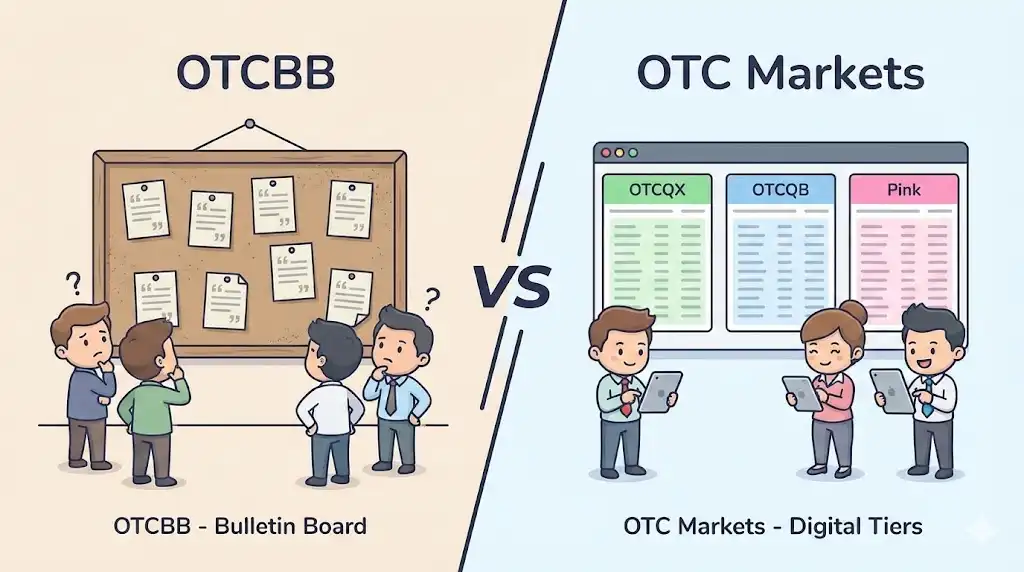
What’s the Difference Between OTCBB and OTC Markets?
What is OTCBB – You’ll hear OTCBB and OTC Markets used interchangeably, but they’re actually two different systems that operated under different standards.
- OTCBB: Was a FINRA-operated quote service, now shut down. It required companies to stay current with SEC filings.
- OTC Markets Group: A private company that runs the OTCQX, OTCQB, and Pink Markets. These are live marketplaces with real-time execution and different tiers based on disclosure and financial standards.
So, technically, if you’re buying an OTC stock today, you’re using the OTC Markets platform, not the OTCBB. But you’ll still see older articles and investor materials referring to OTCBB, especially if the stock’s been around a while.
Common Issues with OTCBB-Listed Stocks
What is OTCBB – Let’s be real, most traders hear “OTC” and run the other way. And for good reason. Even when the OTCBB was active, these stocks had a reputation for being volatile, illiquid, and prone to pump-and-dump schemes.
You’d get companies with no revenue or even business operations issuing press releases and riding up on pure hype.
Some common problems traders and investors faced:
- Lack of liquidity: It wasn’t unusual to hold a stock for days (or longer) because no one was on the other side to buy.
- Wide spreads: A bid-ask spread of 10–20 percent was not uncommon. That’s brutal for retail traders.
- Information scarcity: Even with SEC reporting, these companies often didn’t give meaningful guidance or financial data.
- Manipulation risk: The lower the float and the fewer the eyes on a stock, the more likely it gets manipulated.
This doesn’t mean everything OTC is trash. Some companies start there before uplisting. But you really had to (and still do) do your homework.
Can Brokers Still Deal with OTC Securities?
In fact, brokers often provide access to OTC Markets stocks, especially if clients ask for it. But it’s not as simple as plugging into a major exchange.
Brokers that deal in OTC equities, especially those that deal in former OTCBB or pink sheet-type instruments, need to have:
- Proper risk controls
- Access to reliable OTC data feeds
- Compliance teams that can monitor for AML, fraud, and manipulation risks
This is particularly important if you’re considering launching a brokerage. Not all liquidity providers offer OTC assets. If they do, you’ll want to understand the structure behind it, how the pricing is sourced, and how to protect your firm from exposure.
Read More: What is Algorithmic Trading? A Complete Guide
Should You Offer OTC Trading in Your Own Brokerage?
What is OTCBB – Understanding the intricacies of market structure, from the old OTCBB to modern electronic execution, is what separates the pros from the amateurs. If you have mastered the trading side, why not step up to the ownership side?
Turnkeyinside provides the technology and support you need to launch your own forex broker or trading platform. You don’t need to build the backend from scratch. We offer white-label solutions that let you focus on growing your business while we handle the technical heavy lifting.
Start your own broker with TurnkeyInside.
